
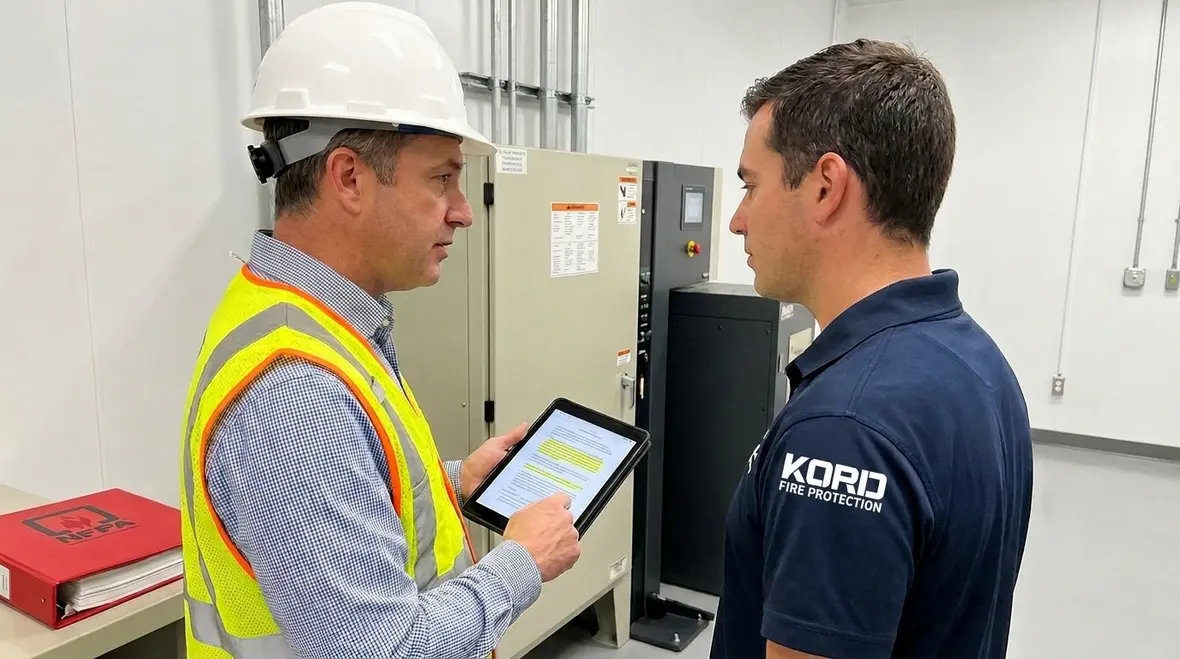
NFPA 37 Section 2.4: Extracts in Mandatory Sections Explained
Quick Answer
NFPA 37 Section 2.4 explains how excerpts are used from mandatory sections. It clarifies that when requirements appear in extracted form, they still carry the same obligation as the full mandatory text. Facilities should treat these “extracts” as enforceable requirements during design, inspection, and maintenance.
If your team is tightening up inspection workflows or documentation controls, code-compliant fire protection services in Southern California can help connect extracted requirements to real maintenance, testing, and deficiency follow-up in the field.
What does “extracts in mandatory sections” mean in NFPA 37 Section 2.4?
In NFPA 37 Section 2.4, the standard sets expectations for how written requirements may be presented as extracted text while remaining binding. This matters in real world inspections because contractors, facility engineers, and inspectors often rely on summarized or copied wording in plans, checklists, and maintenance instructions. The key compliance point is that NFPA 37 mandatory section extracts references are not “optional shortcuts.” When an extract is taken from a mandatory section, it retains the enforceable nature of that underlying requirement.
Commercial and industrial facilities commonly encounter this issue when procurement documents, startup packets, or third party inspection reports quote requirements instead of referencing the full section. Section 2.4 provides the interpretive rule that prevents those excerpts from being treated as guidance rather than requirements.
How Section 2.4 affects design, installation, and plan review
For facilities building new equipment or modifying existing systems, NFPA 37 requirements often flow into site specific documentation. Even when a compliance package includes excerpts, the facility still must design to the underlying mandatory intent, not just the extracted wording.
1) Plan review and AHJ alignment
Plan reviewers frequently ask for clear evidence that mandatory safety functions are addressed. Extracts can help speed documentation review, but they must not dilute obligation. The practical standard operating procedure is to cross verify every extracted requirement against the full mandatory section before submission.
2) Basis of design and equipment submittals
Equipment vendors may provide submittals that reference only selected clauses. When those clauses are mandatory extracts, the facility should require the vendor to demonstrate compliance for the entire requirement, including details that might not appear in the excerpt. This reduces the risk of late corrections that disrupt commissioning schedules.
3) Change management during construction
Change orders frequently lead to “it is still compliant because the extract is the same” arguments. Section 2.4 discourages that approach. Any change that affects system operation, control logic, safety interlocks, ventilation strategies, or fuel handling practices must be evaluated against the complete mandatory clause, not only the copied extract.
Where extracted mandatory wording shows up on site (and why it fails)
In commercial, industrial, and retail environments, NFPA 37 compliance often involves multiple trades and periodic verification. Extracted mandatory language appears in three common places, and each one creates predictable failure points.
Common document locations
- Operating procedures and startup checklists
- Inspection and testing templates for periodic service
- Contractor commissioning notes and deficiency closure records
Common failure points
- Loss of operational context: An extract may omit conditions, exceptions, or sequence requirements found in the full text.
- Mismatch between documentation and field conditions: A checklist might quote the extract correctly but measure the wrong parameter or tolerate unacceptable variance.
- Weak maintenance instruction wording: Maintenance staff may treat the extracted text as “what to look for,” rather than “what must be met,” causing drift over time.
- Inconsistent training across shifts: Extract based training can lead to different interpretations unless the facility standardizes against the complete mandatory clause.
These failures often surface during semiannual or annual inspections, when testing results do not align with expectations formed from partial wording.
Compliance operations: what facilities should do with NFPA 37 mandatory section extracts references
Facilities can operationalize Section 2.4 into a practical compliance workflow. The goal is to ensure extracted mandatory text gets treated as binding while supporting accurate field verification.
Step 1: Build an extract verification matrix
Create a matrix that links each excerpt used in site documents to the full mandatory section it was taken from. Include fields for system ID, test method, acceptance criteria, and maintenance responsibility. This directly supports repeatable compliance for commercial facility management teams.
Step 2: Standardize test and acceptance language
When testing procedures rely on extracts, the facility should ensure test steps and acceptance criteria cover the complete requirement. Where an extract reduces detail, maintenance should reference the complete mandatory clause in the underlying procedure, not in the operator facing summary.
Step 3: QA checks at each maintenance cycle
Before performing recurring inspection activities, facilities should confirm the procedure version matches the latest documented requirement. This reduces the risk of outdated extracts being reused. It also improves audit defensibility.
Step 4: Capture evidence that demonstrates mandatory compliance
Field evidence should include more than checkmarks. It should show the system met the requirement in measured or observed terms, including instrument readings, calibration references where applicable, and corrective actions if thresholds are not met.
For teams seeking a disciplined approach to ongoing testing and documentation control, Kord Fire Protection supports commercial operations with inspection and maintenance processes designed around the full lifecycle of fire protection servicing, helping align field work with how mandatory requirements are enforced in practice.
How Kord Fire Protection supports Section 2.4 compliant maintenance and testing
Section 2.4 creates an interpretation risk: extracted text can look simplified, but it stays mandatory. Kord Fire Protection helps reduce that risk by supporting facilities with clear maintenance expectations, inspection readiness, and evidence quality.
- Procedure alignment: Maintenance and inspection documentation gets cross checked against mandatory source requirements so extracted wording does not become a loophole.
- Field verification support: Testing and observation methods remain tied to measurable safety functions, not just written extracts.
- Documentation quality: Reports and deficiency records are structured to support review by internal safety teams, ownership, and authority having jurisdiction processes where applicable.
If your facility uses checklists that quote NFPA 37 text, partnering with Kord Fire Protection can help ensure NFPA 37 mandatory section extracts references are translated into correct field actions and defensible results.
For additional resources related to fire protection compliance planning and service execution, visit Kord Fire Protection.
Frequently Asked Questions
Call to action
If your facility relies on NFPA 37 text extracts in operating procedures, inspection checklists, or maintenance instructions, validate them against the full mandatory clauses now. Kord Fire Protection can help your team maintain defensible documentation, correct field testing, and reliable compliance outcomes across commercial, industrial, and retail systems. Contact Kord Fire Protection to align your maintenance and inspection program with how mandatory requirements are enforced.

Join Our Newsletter!
Get the latest fire safety tips delivered straight to your inbox From our Newsletter.



