
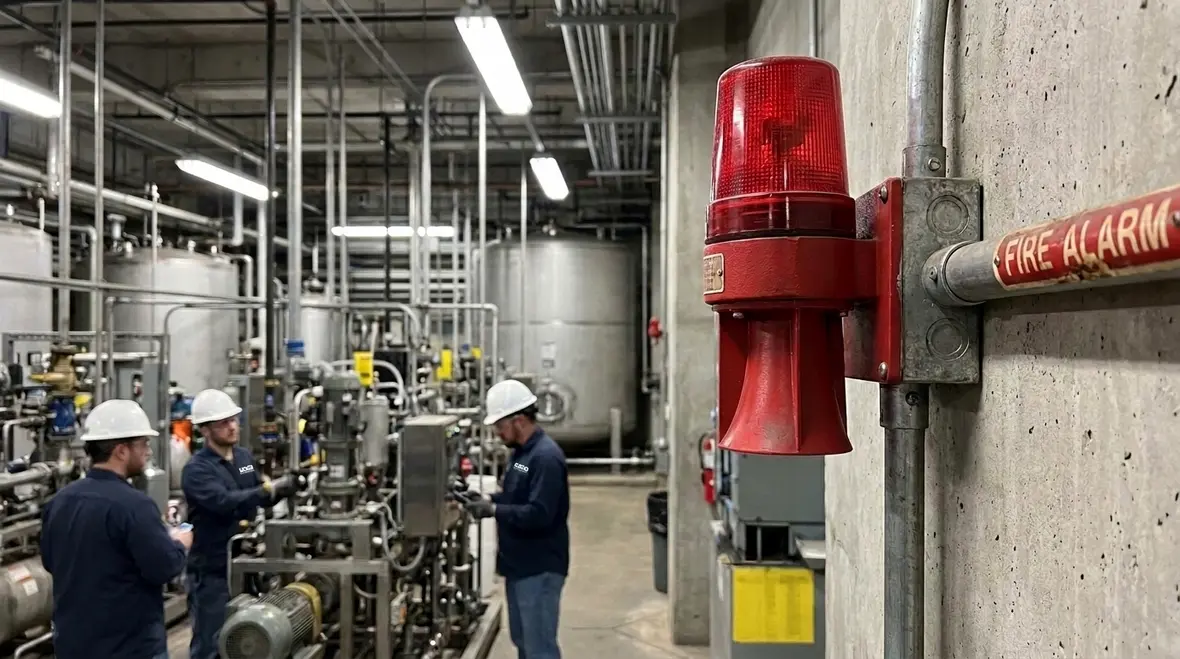
NFPA 35 Section 11.4: Emergency Notification for Hazardous Industrial Facilities
Quick Answer
NFPA 35 Section 11.4 sets operational expectations for emergency notification so personnel can respond quickly and safely. For the NFPA 35 emergency notification requirements plant, facilities must ensure prompt alerting, defined coverage, reliable message delivery, and documented testing and maintenance of the notification system.
Emergency notification in chemical and hazardous process environments cannot rely on improvised calling, partial coverage, or equipment that works “most of the time.” NFPA 35 Section 11.4 focuses on the ability to notify people in a timely, coordinated manner so they can execute emergency procedures.
Facilities that are reviewing notification readiness often also benefit from evaluating their broader commercial fire alarm services approach, especially where inspections, maintenance, monitoring, and device performance all influence how fast alerts actually reach people.
What NFPA 35 Section 11.4 Means for Emergency Notification
NFPA 35 addresses fire protection features and safeguards for facilities handling hazardous materials. Within that framework, Section 11.4 addresses the emergency notification function: the facility must be able to rapidly communicate an emergency condition to occupants and other relevant parties in a way that supports life safety and emergency response.
In practical terms, this means notification is not a one time purchase decision. It is an ongoing capability built on correct system design, clear message intent, reliable hardware, and documented verification. For operators, the compliance standard is about performance under stress: when alarms are needed, they must be audible, intelligible, and dependable throughout the covered areas.
The NFPA 35 emergency notification requirements plant expectation typically intersects with how industrial occupancies manage alarm audibility, staffing response, escalation workflows, and the integrity of alarm pathways.
Notification Objectives: Coverage, Speed, and Actionability
Emergency notification systems in NFPA 35 protected environments should meet three objectives: coverage, speed, and actionability.
1) Coverage that matches the facility hazard reality
Facilities often assume that if fire alarm coverage meets a general code standard, it automatically satisfies emergency notification needs. In many plants, however, the work areas that create the highest risk are not the same as the areas most frequently occupied. NFPA 35 emergency notification requirements plant compliance is commonly tested by verifying that occupants in the hazard relevant zones can be alerted effectively.
- Process rooms, transfer areas, loading zones, and maintenance bays may require dedicated coverage.
- Warehouse and retail adjacent spaces may need zoning coordination if materials and ignition hazards span multiple occupancies.
- Audibility targets depend on ambient noise and layout, not on “installed volume.”
2) Speed: alarm activation and notification initiation
Speed is determined by the initiation sequence and the reliability of the alarm pathways. Common failure points include delayed activation logic, annunciation delays, and reliance on personnel to manually transmit alerts. A compliant system supports a prompt alarm initiation path so the emergency notification function does not depend on a single human action.
3) Actionability: message format and operational clarity
Notification is not only about sounding an alarm. It must convey enough operational intent to support emergency procedures. Many facilities implement pre planned messages that align with evacuation, shelter, shutdown, isolation, or response team staging.
System Design Mechanisms: How Emergency Notification Typically Works
Most NFPA 35 emergency notification implementations use notification devices integrated with fire alarm or emergency communication equipment. The key compliance question is whether the system performs the intended alerting function reliably and consistently across its coverage zones.
Core components that control notification delivery
- Initiation and control: alarm control unit or emergency control logic that starts notification on an emergency input.
- Notification appliances: audible and, where needed, visible or other alerting devices designed for the environment.
- Power supervision: battery and power supply arrangements with fault monitoring and replacement schedules.
- Signaling pathways: wiring, circuits, and protection strategies that maintain integrity during system stress.
- Supervision and monitoring: trouble signals, device status monitoring, and event logging for verification.
Where plants see real world noncompliance
Audits and inspection findings often cluster around predictable weaknesses. Common issues include:
- Insufficient audibility or intelligibility due to aging devices, new machinery noise, or layout changes.
- Dead or weak zones from incorrect device placement or obstructed lines of sound.
- Power or supervision faults that do not get corrected quickly enough.
- Maintenance gaps where devices are not periodically cleaned, tested for output, or verified for alignment with current occupancy.
- Unmanaged modifications from construction, tenant fit outs, or process upgrades that change the coverage needs.
Inspection, Testing, and Maintenance: The Compliance Lifecycle
Emergency notification systems remain compliant only when they stay reliable. For the NFPA 35 emergency notification requirements plant, compliance is verified through ongoing testing, documented records, and responsive repairs after faults.
Operational testing expectations
Commercial facilities typically perform staged testing that confirms initiation, device operation, and message delivery across relevant zones. Testing should verify that notification devices are functioning as intended, and that fault conditions trigger the required trouble indications.
Common maintenance requirements that prevent failures
- Battery management: maintaining battery condition, load capacity, and scheduled replacements.
- Device output verification: confirming audible performance and visual operation where required.
- Controller and wiring inspection: ensuring no loose terminations, corrosion, or circuit damage.
- Event log review: validating that tests and real events are recorded for traceability.
If the facility has commercial retail interfaces, shared corridors, or multi tenant spaces, maintenance and testing must also account for changes in occupancy patterns. Kord Fire Protection supports these lifecycle needs with routine program management and field verification so the notification capability remains dependable after modifications.
For related alarm system readiness considerations, facilities often also review how alarms are managed and maintained through the lens of fire alarm inspection services, which align well with the ongoing verification expectations that emergency notification depends on.
Plant and Commercial Integration Challenges (Industrial, Retail, and Multi Use)
Many facilities combine manufacturing, warehouse operations, offices, and retail adjacent spaces. That creates complex emergency notification scenarios where audibility and visibility requirements must consider different ambient noise levels, occupant familiarity, and evacuation routes.
Coverage coordination across occupancy types
A plant that includes break rooms, loading docks, and retail storefront adjacent areas often has different sound conditions in each space. Emergency notification should not be “one setting fits all.” Instead, zoning and device selection should reflect how people move and where they are located during an emergency.
Changes after construction or process upgrades
Process improvements frequently add equipment, reconfigure walls, and change airflow patterns, which can alter sound propagation and device performance. The compliance gap appears when the emergency notification system is not rechecked after changes.
Operational behavior and staff response training
Even a well designed system can underperform if staff response is inconsistent. Emergency notification should be tied to training so employees understand what the alert means and what actions to take immediately.
How Kord Fire Protection Helps Maintain NFPA 35 Emergency Notification Readiness
Kord Fire Protection works with commercial and industrial operators to sustain dependable emergency notification performance, especially in environments where modifications and operational complexity increase the risk of coverage and reliability drift.
- Assessment: review of coverage strategy, device performance considerations, and integration with emergency control logic.
- Testing support: structured verification aligned with the facility’s alarm zoning and operational workflows.
- Maintenance planning: scheduled checks that address the most common failure points such as power supervision, device output, and fault response.
- Documentation readiness: support for records that demonstrate ongoing compliance capability.
To reinforce broader inspection discipline across fire safety systems, Kord also supports commercial operators through inspection services that help keep documentation and field readiness aligned.
Frequently Asked Questions
Conclusion and Call to Action
NFPA 35 Section 11.4 emergency notification readiness depends on more than an installed alarm system. Facilities must maintain coverage performance, ensure prompt initiation and reliable signaling, and document testing and corrective actions. If your plant has ongoing construction, process changes, or mixed occupancy areas, schedule a compliance focused review with Kord Fire Protection. They can help verify emergency notification performance and build a maintenance plan that sustains reliability between inspections.

Join Our Newsletter!
Get the latest fire safety tips delivered straight to your inbox From our Newsletter.



