
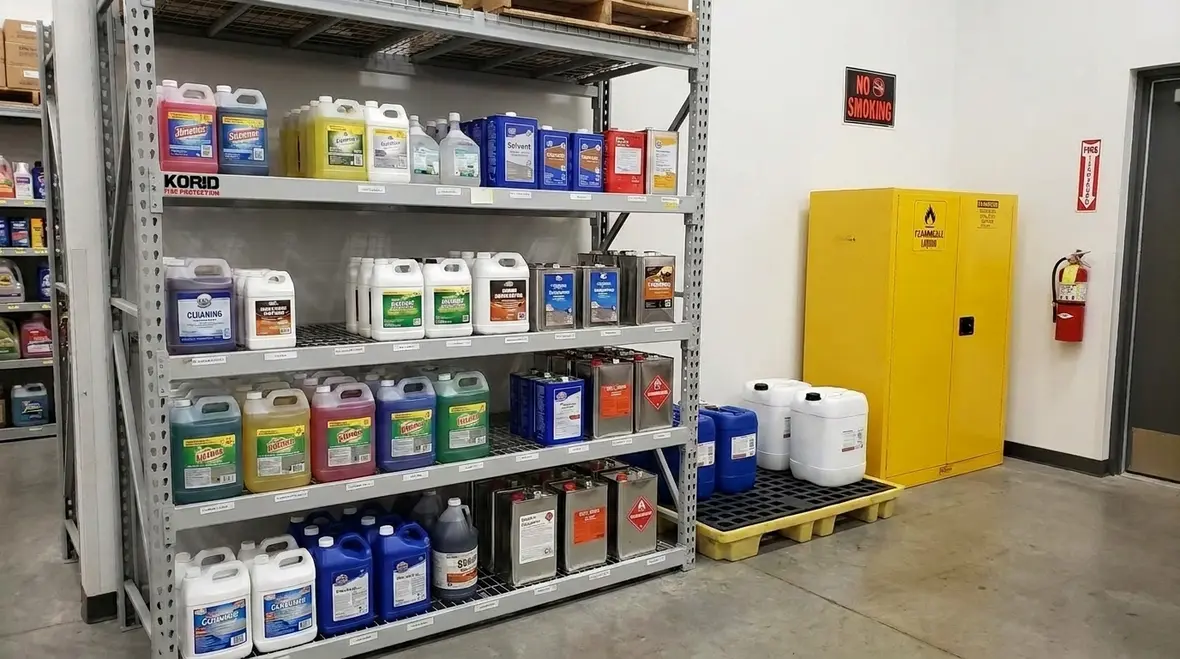
NFPA 30 Section 10.1 Scope: Container Storage in Mercantile Occupancies
Quick Answer: NFPA 30 Section 10.1 defines how containerized flammable and combustible liquids must be stored in mercantile occupancies. It focuses on the storage arrangements, container controls, distance and separation concepts, and inspection-ready practices that reduce ignition and fire growth risk.
For facilities tightening inspection readiness, Kord Fire Protection also offers commercial fire suppression system services that fit naturally into broader liquid hazard protection planning.
What does the NFPA 30 Section 10.1 scope cover in mercantile container storage?
The NFPA 30 Section 10.1 scope mercantile container storage addresses the requirements for storing flammable and combustible liquids in containers within mercantile occupancies, such as retail service areas, showrooms with maintenance supplies, and accessory storage rooms used to support business operations. The intent is to regulate the fire load, limit propagation, and support safe operations through enforceable storage and housekeeping controls.
In practice, commercial teams often interpret “scope” as just a set of container rules. In reality, Section 10.1 ties container storage to broader life safety outcomes: safe access for response, controlled ignition sources, consistent container condition, and storage systems that can be inspected and maintained without ambiguity.
Where Section 10.1 applies (and where it often gets misapplied)
NFPA 30 Section 10.1 focuses on container storage in mercantile occupancies. Common scenarios include:
- Retail supply storage adjacent to sales floor or back-of-house rooms.
- Fuel, aerosol, solvents, cleaners, and related liquids stored in approved containers for business use.
- Small to moderate bulk quantities stored in containers rather than in tanks.
- Storage in areas that remain “commercial” in character, even when liquids support maintenance or operations.
Misapplication typically occurs when facilities treat mixed liquid classifications as identical, store containers in unapproved racks, or assume that spill control equals fire control. Kord Fire Protection frequently sees compliance gaps where containers are stored too close to ignition hazards, blocked from access, or placed in locations that do not support safe inspection and spill management.
Operational reality: “container storage” still needs a complete storage system
Even when containers are compliant, the storage setup must support safe conditions. That includes stable placement, secondary containment where required by the storage arrangement, and clear separation from ignition sources such as electrical panels, heaters, open flame processes, or uncontrolled repair activities.
Key compliance themes: arrangement, ignition exposure, and container control
Section 10.1 operates like a practical barrier against three high-consequence problems: container failure, ignition exposure, and uncontrolled spread. Commercial facilities should evaluate their program using these operational themes.
1) Container condition and integrity
NFPA 30 requirements rely heavily on the assumption that containers remain serviceable. Facilities must prevent deterioration through:
- Routine checks for corrosion, damaged seams, loose caps, bulging, and leakage.
- Correct labeling and segregation based on liquid type and compatibility goals.
- Replacing containers that cannot maintain an effective seal.
A common failure point arises when containers are “managed by inventory,” not “managed by condition.” Staff may rotate stock but skip structural inspection, especially in high throughput retail environments.
2) Separation from ignition sources and heat
Mercantile occupancies often contain abundant potential ignition sources. Compliance requires storage arrangements that limit ignition exposure from ordinary and abnormal conditions. That typically means controlling proximity to:
- Electrical equipment likely to spark or arc.
- Space heaters, drying equipment, and other heat sources.
- Work areas where repair, grinding, or hot work may occur.
- Traffic patterns that can physically damage containers.
Where the facility shares walls with other business functions, the storage location should support safe response access and reduce heat or flame impingement risk.
3) Storage layout that supports inspection and emergency access
Fire codes expect stored liquids to be observable and inspectable. That means establishing clear sightlines and access paths rather than “stacked tight” storage. Containers should be positioned to allow inspectors to verify labeling, condition, and arrangement without moving large quantities or dismantling storage systems.
If the storage setup forces staff to remove containers just to verify compliance, the system will drift out of alignment over time.
Commercial inspection and maintenance practices that keep you audit ready
NFPA 30 compliance does not remain static. Mercantile storage changes with purchasing cycles, seasonal demand, staff turnover, and product substitutions. To maintain the intent of NFPA 30 Section 10.1 scope mercantile container storage, facilities need a documented, repeatable maintenance routine.
Inspection checklist you can operationalize
- Area verification: Confirm storage remains in the intended mercantile storage area with controlled access and appropriate housekeeping.
- Container verification: Check seals, caps, labels, and signs of leakage or corrosion.
- Arrangement verification: Confirm containers remain in the approved placement scheme, with no unauthorized substitutions or improvised stacking.
- Spill control readiness: Ensure absorbents, containment materials, and disposal steps remain accessible and in serviceable condition.
- Ignition control: Confirm storage is not creeping toward ignition sources due to merchandising or operational changes.
- Housekeeping: Remove combustibles that accumulate around storage areas, including cardboard, rags, and packaging residues.
Maintenance and drift control
Drift happens when departments share the space. For example, the receiving team stores additional packaging “temporarily,” or a maintenance team places new items in a convenient corner. Kord Fire Protection helps commercial operators establish a compliance rhythm that aligns with retail realities, including change control for new products and periodic verification of storage arrangements.
Common failure points in mercantile container storage programs
Failures usually come from gaps between the written program and day to day behavior. The most frequent problem areas include:
- Incorrect storage location: Containers placed in a general work area rather than a controlled storage space.
- Mixed incompatible products: Liquids stored together without practical segregation controls, increasing risk during a leak event.
- Improper rack or platform use: Non rated shelving, unstable stacking, or storage that blocks inspection and ventilation assumptions.
- Uncontrolled container modifications: Transfer into unapproved vessels or using damaged containers as “serviceable” spares.
- Delayed spill response capability: Spill supplies missing, expired, or stored behind obstacles.
For a broader understanding of how NFPA 30 regulates flammable liquid controls, operators can also reference this technical resource: How NFPA 30 regulates flammable liquids.
How Kord Fire Protection supports ongoing Section 10.1 compliance
Compliance succeeds when fire safety engineering and operational maintenance work together. Kord Fire Protection supports mercantile facilities by providing practical, inspection-ready assistance across container storage programs, including:
- On site assessment of storage layouts, access paths, and ignition exposure controls.
- Program support for inspection routines and corrective action tracking.
- Maintenance guidance for keeping containers and storage systems in a continuously compliant state.
- Documentation support that helps demonstrate due diligence during audits and inspections.
Commercial teams benefit most when the compliance plan accounts for merchandising pressure, staffing changes, and product turnover. Kord Fire Protection (kordfire.com.au) helps bridge the gap between code intent and real world storage behavior.
Frequently Asked Questions
Next step: make your container storage inspection ready
If your mercantile area stores flammable or combustible liquids in containers, schedule a compliance review to confirm your layout, container control practices, access paths, and ignition exposure controls align with NFPA 30 Section 10.1 scope mercantile container storage. Kord Fire Protection can help you close gaps before an inspection finds them and build a practical maintenance routine that stays compliant as product lines and staff change.

Join Our Newsletter!
Get the latest fire safety tips delivered straight to your inbox From our Newsletter.



